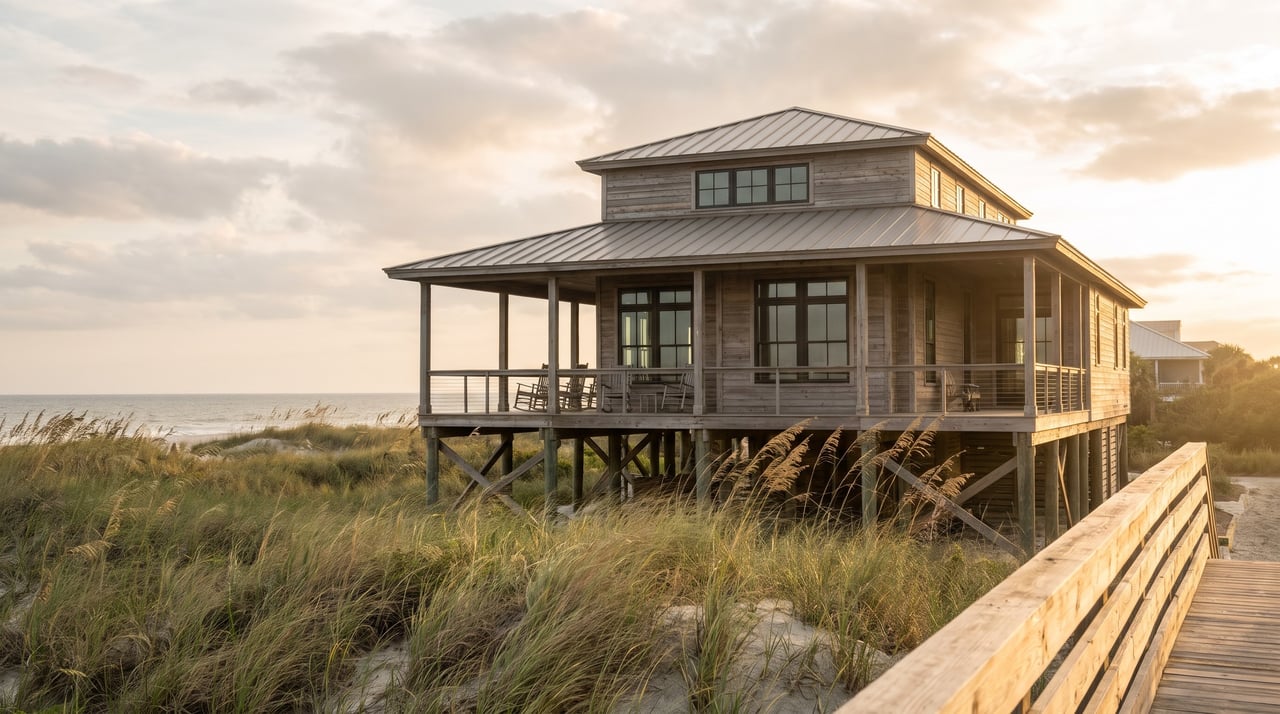
Homeowners insurance in South Carolina is high for three reasons the state itself names: repairs cost more because materials and labor cost more, insurers pay more for their own backup coverage (reinsurance), and homes are worth more, so people buy higher limits. That comes from the SC Department of Insurance 2025 Coastal Property Report (January 31, 2026). On the Grand Strand you add wind risk on top, which is why the house itself (roof, windows, how it is tied together) moves your quote more than almost anything else.
The good news is you can still get coverage here. The same report says 92% of coastal homeowners found a policy in the regular market, and that "there has been no mass exodus by insurers from the South Carolina coast."
What is driving the price up?
The state report names three causes: repair costs, reinsurance, and higher home values. Here is what each one means in plain words.
Repair costs went up first. Lumber and roofing cost more, and so does labor. Insurance prices lag behind because a rate change has to be studied and approved before it takes effect.
Reinsurance is insurance for insurance companies. The report says reinsurance rates "have surged" after big storm losses around the world, and insurers raised their own rates to cover it.
Higher values are the part people forget. A home that sold for $900,000 a few years ago may need a much bigger policy today just to rebuild it.
One more thing. A storm does not have to hit the beach to raise your bill. Hurricane Helene came ashore in Florida in 2024 and moved inland through Georgia and South Carolina. By the end of 2025 it had produced 137,488 residential property claims in South Carolina, with $1.43 billion in losses, per the same DOI report. Those losses get paid by the whole state's book of business, including us on the coast.
Can you still insure a beach house on the Grand Strand?
Yes, for most homes. South Carolina has a "market of last resort" for wind, the SC Wind and Hail Underwriting Association (people call it the wind pool). It is there when a regular insurer will not write wind on a coastal home. At its peak in August 2011 it had 47,366 policies. At the end of 2025 it had 15,337. Fewer people need it, because more insurers are writing wind on the coast again.
Now the honest part. The same report says "some homeowners with larger homes near the coast have experienced difficulties renewing their insurance coverage," and older condo buildings near the ocean have had the hardest time. So "you can get coverage" is true. "Every house is easy to insure" is not.
What does wind coverage cost on the Grand Strand?
The best public price data for our two counties is the wind pool's own book. It is wind-only coverage, and it is the backup market, so most people pay a regular insurer instead. But it gives you a real, sourced number to measure against.
Wind pool, year-end 2025 | Horry County | Georgetown County |
|---|---|---|
Policies | 7,760 | 1,855 |
Yearly premiums | $23.4 million | $7.1 million |
Coverage written | $2.35 billion | $902 million |
Cost per $100,000 of coverage | about $1,000 | about $790 |
Source: SC Department of Insurance 2025 Coastal Property Report, Table 2.4 (both wind zones added together). The cost per $100,000 is my math on the state's numbers.
Those rates went up again. The wind pool filed for a 7.5% increase on homes, the state approved it, and it took effect February 1, 2026.
To put that on a real Grand Strand home: I pulled our MLS on November 9, and the median $1M+ single-family home that closed in Horry and Georgetown counties this year sold for $1,413,750 (370 sales, January 1 to November 8, 2026). You do not insure the sale price. You insure what it costs to rebuild the house.
Still, at the wind pool's average rate, every $100,000 of wind coverage on that home runs about $1,000 a year in Horry. The average wind pool policy in Horry only covers about $302,000, so a $1.4M house sits well above the typical policy in that book.
Why does the house itself change the quote so much?
Because wind damage starts in a few places: the roof covering, the roof deck, where the roof meets the walls, and the windows and doors. Make those stronger and the insurer's risk drops.
South Carolina law backs you up here. Under SC Code 38-75-755, your insurer has to tell you, when the policy is written and at every renewal, what wind discounts and credits are available and what you can do to lower your wind premium. It also has to tell you if your policy has a separate hurricane, wind or named storm deductible.
The state's SC Safe Home program lists the upgrades it pays for, which is a good map of what insurers care about:
- A stronger roof deck attachment and a secondary water barrier under the shingles
- A high wind-rated roof covering, braced gable ends, and stronger roof-to-wall connections
- Impact-rated windows, doors and garage doors, or code-approved protection on every opening
The DOI says homeowners who did these upgrades through Safe Home report premium savings of up to 24% from their insurers.
I was the project manager for a builder of luxury custom homes, and most of this work is out of sight once a house is finished. You cannot see a roof-to-wall strap through drywall. That is why the paperwork counts. Permits and roof install records prove what is up there. Window labels and a wind mitigation inspection prove the rest.
The catch for second-home buyers: Safe Home grants only go to an owner-occupied, single-family primary residence in a coastal county. A second home does not qualify, and as of today the program page says it is not taking applications.
What about condos?
On a condo, a big part of your insurance bill hides inside the HOA dues, because the association buys the policy for the building.
On a buyer call on October 28, I said it this way: "We want to look into HOAs, because sometimes there's insurance assessments. I've seen HOAs that have gotten up to $1,300 a month."
The state report shows why. Condo buildings made of wood, over 50 years old and close to the ocean, have had the most trouble finding affordable coverage. So before you buy a condo, read the association's master policy, its budget, and any special assessments from the last few years.
Is flood insurance part of this?
No. A homeowners policy does not cover flood. Flood is a separate policy, usually through FEMA's National Flood Insurance Program or a private flood insurer.
There is a date to watch. The NFIP is authorized through December 11, 2026 (NAR flood insurance FAQ). If Congress lets it lapse, the NFIP cannot write new or renewal policies until it is reauthorized. A buyer can still take over the seller's existing NFIP policy at closing, and private flood insurance is not affected. If you are closing on a home in a flood zone in December, ask your lender about this now.
What should you do before you go under contract?
Get insurance numbers during your due diligence, not after. Here is a short list you can use:
- Ask for the seller's current declarations page. It shows the coverage, the premium and any separate hurricane deductible.
- Find out the roof's age and type, and ask for the install paperwork.
- Ask for any wind mitigation inspection, window and door labels, or permits for storm upgrades.
- Get at least two quotes from an independent agent who writes coastal homes.
- Check the flood zone, and ask for an elevation certificate if the home has one.
- For a condo, get the master policy and the last few years of assessments.
South Carolina also allows a catastrophe savings account, where you can set money aside free of state income tax to pay hurricane deductibles (SC DOI flyer). Ask your CPA if it fits you.
If you want to see how insurance and taxes stack up together, my post on second-home property taxes in South Carolina runs the tax side on the same $1.4M home. For the market numbers, see what the MLS shows for $1M+ homes.
FAQ
Is homeowners insurance going up in South Carolina in 2026? For coastal wind, yes. The wind pool's 7.5% increase on homes took effect February 1, 2026. Regular insurers file their own rates, so your change depends on your company.
Can I get a Safe Home grant on a second home? No. The program is for an owner-occupied primary residence that is a single-family, freestanding home.
Does a newer home cost less to insure? It depends on the features more than the year. Wind credits are tied to how the roof, walls and openings are built, and state law says your insurer has to tell you which ones it offers. Bring the paperwork either way.
I am not an insurance agent, and nothing here is a quote. Rates change by company and by house. If you are buying or selling on the Grand Strand and want insurance on the list from day one, call me at (843) 284-7969 or reach me here. You can also browse luxury homes for sale in Myrtle Beach or read my Myrtle Beach area guide.
Sources
- SC Department of Insurance, 2025 Status Report on the South Carolina Coastal Property Insurance Market (January 31, 2026)
- SC Code 38-75-755
- SC Safe Home grant program (viewed November 16, 2026)
- NAR, NFIP expires December 11, 2026 FAQ
- Coastal Carolinas MLS (Paragon), $1M+ single-family closings in Horry and Georgetown counties, January 1 to November 8, 2026, pulled November 9, 2026